"In our industry I see great potential between the Czech Republic and India, which could be significantly developed through cooperation in the form of joint ventures," says Shashidhar Singh, CEO and Managing Director of DINA - HITEX, a leader in the production and distribution of disposable medical devices and one of the founders of the Czech-Indian Chamber of Commerce.
Even the sweeping changes in the global economy after the collapse of the Eastern Bloc did not erase the strong reputation that Czechoslovak products and services enjoy in India. "For example, the Baťa brand became so familiar in India that Indians today consider it their own. After 1989, newly established Czech companies that built upon the long tradition of Czechoslovak industry further strengthened the respect of Indian customers through the quality and competitiveness of their products. It is remarkable in how many technologically demanding industries a country of ten million people can keep pace with much larger and stronger economies," says the graduate of the Faculty of Mechanical Engineering at the Brno University of Technology, expressing his admiration.
My drawing board proved useful in the company
The Bučovice-based company established itself in India in 2015, twenty years after stabilizing in the domestic market and in many European countries. And what was the most challenging aspect of starting a business in the medical devices sector in the 1990s?
"Maintaining financial stability at a time of weak payment discipline and building high-quality technical facilities," answers Shashidhar Singh. "Powerful machines from leading global manufacturers were available, but they were also very expensive. As a mechanical engineer, my knowledge and experience with designing and operating machinery proved extremely useful. In cooperation with a local company, we therefore designed the first semi-automatic machines ourselves. The weaker point was finance. During the first years we supplied products only to state healthcare facilities, where payment discipline was poor and delays often lasted months or even years."
In the last ten years, the financial environment has improved in most cases, but many new problems have emerged. The market has become more sophisticated, legislation is constantly increasing - not only regarding product quality and safety but also environmental protection and employee welfare - and customers are raising their expectations. "Our production portfolio consists of disposable surgical sets manufactured according to the individual requirements of the customer. With long-term partners - often with twenty-five to thirty years of mutual business relationships - we cooperate on outlook plans for the structure and parameters of deliveries that precede specific orders. The advantage of such a process is that both sides can realistically set their strategies and prepare for implementation."
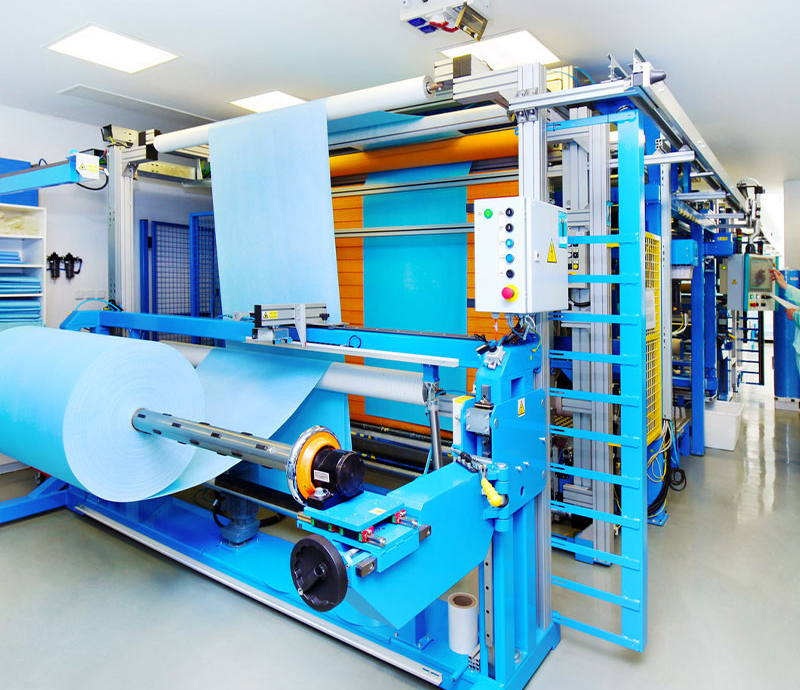
On the automated production line, daily output exceeds twelve thousand surgical drapes.
Demanding legislation and limited supplier capacities
Manufacturers of medical materials and devices - particularly from EU countries - face a significant burden due to the cost of certification, product safety verification and highly qualified specialists in this field. At DINA - HITEX, for example, nine employees work in this area.
"These costs reach tens of millions and due to the rapid pace of innovation and the insufficient number of certification authorities in the EU - there are only about thirty - we sometimes wait up to two years for approval of a new product. Testing new materials can cost up to ten thousand euros and training employees and distributors also requires considerable funds. Only financially strong companies can withstand such conditions," the manager notes, referring to the results of a recent European market survey showing that up to fifty percent of smaller and medium-sized manufacturers are considering ending their business activities.
However, there are some entirely unpredictable problems arising as well - ones that even the famous Czech ability to improvise or the resources of a large company cannot solve. These concern alternative materials. "For example, viscose is currently in high demand in our industry. But in the whole of Europe there are only about three manufacturers, whose capacities are limited. This situation requires us to order it months in advance. But what happens if our supplier cannot meet their commitments due to technical or other reasons? On the strictly regulated European market, where we can purchase materials only from approved suppliers, we can easily end up trapped."
Despite this, DINA - HITEX prefers proven suppliers from the Czech and European regions - not only due to legislative requirements but also because of logistics, delivery speed and quality. "We obtain packaging materials mainly from the Czech Republic, production materials mostly from Spain, Germany and the UK and sterilization packaging from France - simply wherever it makes the most business sense."
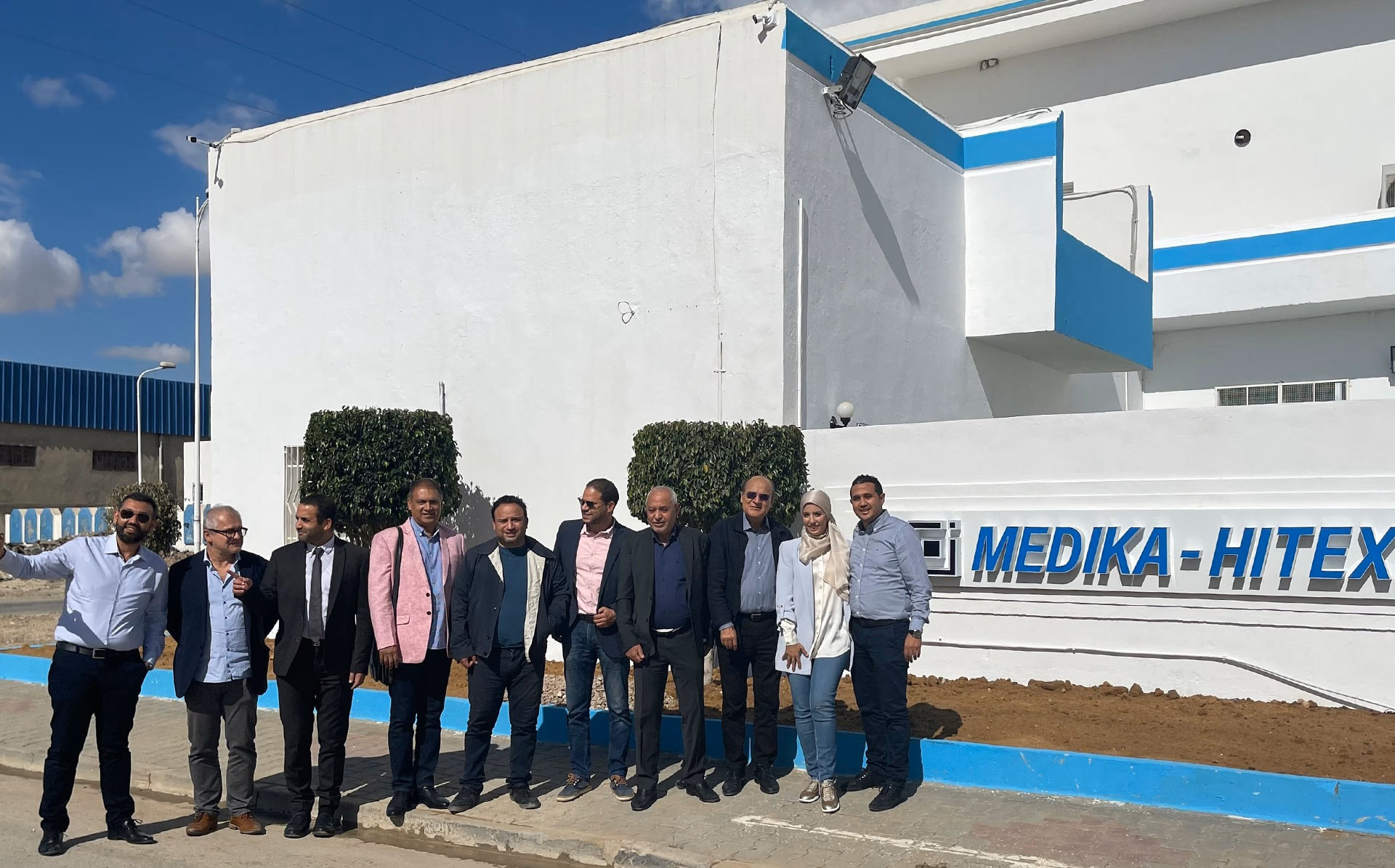
With colleagues during a visit to the Tunisian plant
We can be flexible and fast. Quality is a given
Exporting to three continents brings many specific challenges. One might expect the greatest differences to be between Europe and developing economies - but that is not the case.
"I see the biggest difference between the Czech and Western European markets. In the Czech Republic negotiations about price are extremely tough and there is insufficient protection against practices of competing companies, particularly from China. Our Western European customers, however, understand that we must comply with extremely demanding European standards in hygiene, quality and environmental protection and they usually fully accept our price offer." Fortunately, flexibility remains the company’s greatest competitive advantage. "Within one month we can develop, manufacture and deliver the requested goods. Chinese competitors cannot achieve this within such a short timeframe," the manager says, pointing to shortcomings in the protection of the Czech business environment.
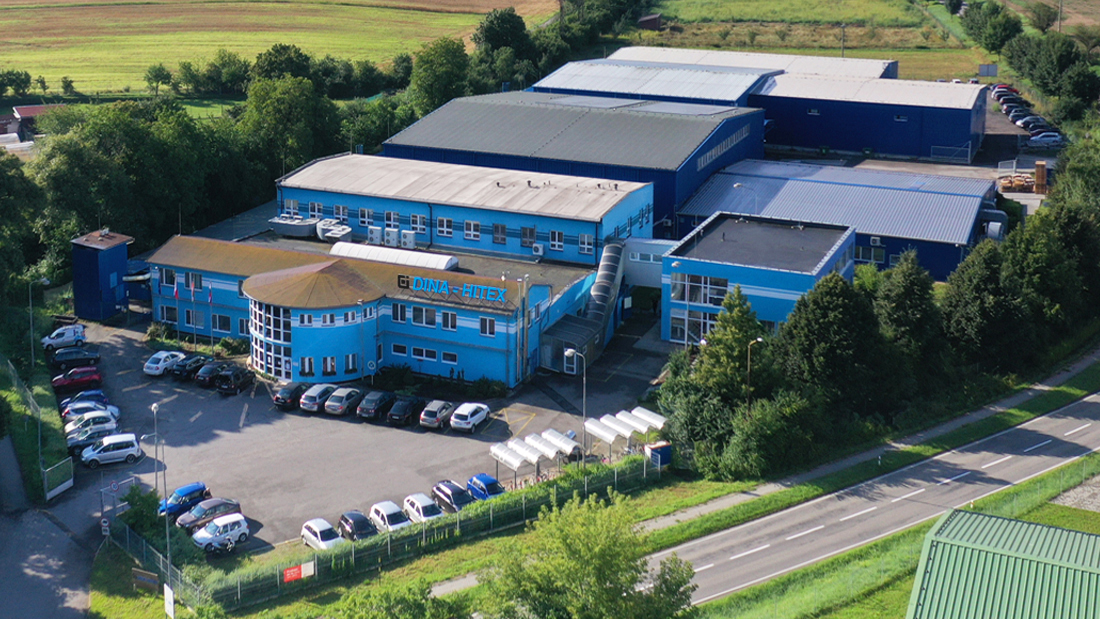
At its Hodějovice plant, DINA - HITEX offers Indian companies a business incubator for an easier start.
We benefit from both localisation and globalisation
In India the company operates two manufacturing plants. One plant in the north of the country supplies the local market, while the second plant - with 320 employees - is located in the state of Gujarat in a special economic zone on the west coast. Another joint plant operates in Tunisia and two more are located in the Czech Republic. Their parameters and modern technologies meet the highest standards for environments used in the production and handling of sterile surgical materials. Four years ago, the company launched a modern facility in Hodějovice in South Moravia, including production and ETO sterilization of final products. A new fully automated high-frequency production line enables the company to process large-volume orders as well. Nevertheless, part of the production programme is still covered by manual manufacturing, which satisfies demand for atypical products. Because, as Shashidhar Singh emphasizes, no customer is too small.
Written by Věra Vortelová
Photo credits: DINA - HITEX
 Indie
Indie